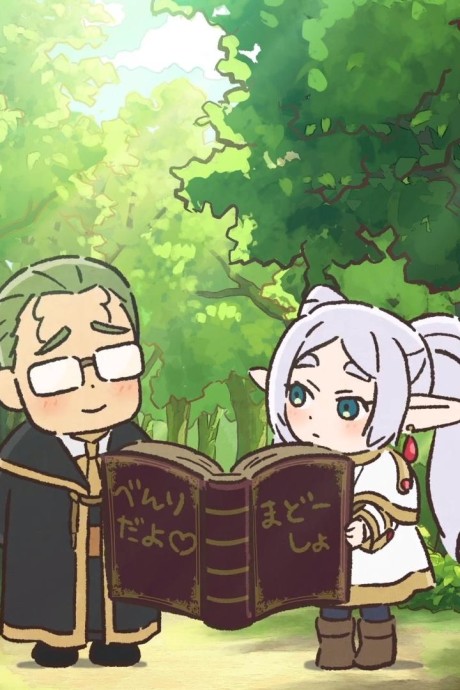
Introduction: The Quiet Revolution of High Fantasy
For decades, traditional high-fantasy storytelling in anime and manga has operated under a well-established structural blueprint. A dark lord threatens the realm, a band of brave heroes embark on a perilous quest, defeat the overarching evil through divine providence or sheer willpower, and the curtain falls as peace is restored. Kanehito Yamada and illustrator Tsukasa Abe posed a simple yet profound question that transformed modern shonen and seinen media: What happens after the hero's quest ends?
Serialized in Shogakukan's Weekly Shōnen Sunday before receiving a historic anime adaptation by Studio Madhouse, Frieren: Beyond Journey's End (Sōsō no Frieren) begins at the literal conclusion of a ten-year legendary crusade. By positioning its narrative in the aftermath of victory, the series shifts the focus from epic conquest to the lingering echoes of human relationships across time. Directed by Keiichirō Saitō—fresh off his triumph with Bocchi the Rock!—the anime adaptation does not merely translate the source material; it elevates it into a meditative masterpiece on grief, memory, and the bittersweet transience of human existence.
Summary: Life After the Happy Ending
Note: The following summary is spoiler-free for major late-game narrative twists and character fates.
The story opens with the Hero’s Party—the noble hero Himmel, the dwarven warrior Eisen, the corrupt priest Heiter, and the thousand-year-old elven mage Frieren—returning to the royal capital after slaying the Demon King. The entire kingdom celebrates their decade-long triumph, but for Frieren, an immortal elf whose perception of time spans centuries, ten years felt like a fleeting blink of an eye. Unbothered by the emotional weight of their parting, Frieren bids her companions farewell and sets off on a solitary fifty-year journey to collect obscure magical spells, promising to meet them again during the next Era Meteors shower.
When Frieren returns half a century later, she finds her former comrades transformed by age. Himmel is now a frail old man, and his peaceful passing shortly after their reunion strikes Frieren with a sudden, crushing wave of grief. Overwhelmed by tears at Himmel's funeral, Frieren realizes with horror how little effort she made to understand him or appreciate the fleeting nature of human lives. Spurred by remorse and a newfound desire to comprehend human emotions, she embarks on a journey toward Ende—the land far north where the Demon King's castle once stood, and where souls are said to congregate—to speak with Himmel once more. Along the way, she takes on Heiter’s adopted apprentice, the stoic young mage Fern, and Eisen’s cowardly yet fierce pupil, the warrior Stark, retracing her past steps and discovering the profound impact her former party left on the world and on her own heart.
In-Depth Narrative & Thematic Analysis
1. The Weight of Time and Impermanence
At the core of Frieren lies a sophisticated exploration of chronological perception. Frieren's immortality isolates her emotionally from mortals; to an elf, a five-year detour to search for a blue moon weed is a minor errand, whereas to a human, five years represents a major epoch of youth, career, or family life. The series uses this friction to build genuine emotional weight. Every village Frieren revisits features statues of Himmel that have slightly eroded, memories of the Hero's Party that have morphed into folk legends, or young descendants carrying on the legacies of people Frieren knew personally.
Rather than drowning in grim nihilism, the narrative frame treats mortality as the very source of human beauty and purpose. Himmel’s brief decades were defined by relentless empathy, small acts of kindness, and a desire to leave the world warmer than he found it. Frieren’s character arc is not about overcoming a dark lord, but about overcoming emotional inertia—learning that because human lives are short, every shared moment carries immense value.
2. Character Dynamics: Legacy, Mentorship, and Quiet Intimacy
The core trio—Frieren, Fern, and Stark—creates one of the most compelling dynamic triads in contemporary anime. Fern acts as the pragmatic, maternal balance to Frieren’s scatterbrained, goblin-like pursuit of trivial magic (such as spells that make shaved ice or remove rust). Yet, their bond is rooted in deep mutual respect. Frieren acts as Fern's magical master, but Fern routinely rescues Frieren from her own emotional detachment and literal traps, such as her recurring run-ins with mimics.
Stark brings a grounded, relatable vulnerability to the group. Unlike typical shonen protagonists who leap fearlessly into battle, Stark is genuinely terrified of violence, trembling before every dangerous encounter. His bravery stems not from a lack of fear, but from choosing to stand his ground despite it, honoring the training bestowed upon him by Eisen. The interactions between Fern and Stark offer a slow-burn, beautifully subtle romance built on awkward teenage miscommunications, shared meals, and quiet support during moments of self-doubt.
3. A Subversion of Magic and Combat Mechanics
In most modern fantasy, magic systems are defined by rigid power levels, mana statistics, or grand elemental transformations. Frieren subverts this by defining magic through the lens of human imagination and psychological certainty. In this world, magic is the art of visualization: a mage cannot cast a spell unless they can clearly picture the result in their mind. This simple rule turns battles into intellectual chess matches rather than raw power displays.
During high-stakes encounters—such as the First Class Mage Exam arc or clashes against the remnants of the Demon King’s army, the Seven Sages of Destruction—fights are brief, kinetic, and lethal. Demons in Frieren are depicted not as tragic anti-heroes, but as predatory monsters that evolved human speech strictly to deceive and hunt human prey. This distinct conceptualization of monsters heightens the tension, contrasting the gentle slice-of-life tone of the travel chapters with razor-sharp, high-risk tactical battles.
Visuals & Audio Production: Madhouse's Masterwork
Animation Style and Art Direction
Studio Madhouse delivered a flagship production that stands among the finest achievements in television anime history. Under Keiichirō Saitō’s direction, the show balances expansive background art with delicate character animation. Backgrounds feature lush alpine forests, sprawling medieval ruins, and vibrant town squares bathed in natural sunlight, giving the world a lived-in, organic quality.
When combat erupts, the production quality skyrockets. Action sequences animated by key animators like Kouki Fujimoto feature dynamic camera movement, incredible weight impact, and particle effects that feel tangible rather than purely digital. The fight between Frieren and her magical clone in the Dungeon Arc remains a gold standard for spatial awareness, choreography, and visual pacing.
Soundtrack and Sound Design
The musical score, composed by American-born composer Evan Call (known for Violet Evergarden), is the emotional heartbeat of the series. Utilizing authentic acoustic instrumentation—including tin whistles, violins, lutes, and orchestral brass—Call weaves a tapestry of Celtic folk melodies and soaring symphonic themes. The soundtrack transitions effortlessly from cozy, acoustic tavern melodies during quiet travel montages to thunderous, epic choral arrangements during combat scenes against high demons like Aura the Guillotine or Macht of El Dorado.
Voice Acting Excellence
The voice cast delivers masterclass performances defined by subtle restraint. Atsumi Tanezaki gives Frieren a calm, slightly detached cadence that subtly warms as the series progresses, conveying subtle shifts in emotion with a slight pitch change or soft sigh. Kana Ichinose captures Fern’s disciplined yet juvenile frustration, while Chiaki Kobayashi imbues Stark with the perfect balance of comedic cowardice and earnest resolve. Nobuhiko Okamoto’s performance as Himmel leaves a lasting impression, radiating charm, nobility, and underlying melancholy in every flashback.
Pros & Cons
To provide a balanced perspective for potential viewers and readers, here is a concise breakdown of the series' core strengths and potential drawbacks:
- Pro: Exceptional thematic storytelling that handles grief, time, and human memory with profound maturity and nuance.
- Pro: Movie-quality animation from Studio Madhouse featuring breathtaking landscapes and world-class combat choreography.
- Pro: Rich, understated character development that respects audience intelligence through visual storytelling rather than endless exposition.
- Pro: An unforgettable, folk-infused orchestral score by Evan Call that elevates every emotional beat.
- Pro: A unique magic system rooted in visualization, philosophy, and tactical strategy rather than arbitrary power scaling.
- Con: Deliberate, reflective pacing that prioritizes atmospheric travel and quiet conversations over non-stop action.
- Con: The main protagonist's intentional emotional restraint may initially feel distant to viewers expecting high-energy shonen leads.
Final Conclusion & Recommendation
Frieren: Beyond Journey's End is a monumental achievement in modern anime and manga. By examining what remains after the glory fades, it breathes fresh life into high fantasy, proving that quiet conversations over hot tea, small acts of kindness, and shared memories can be just as thrilling as slaying dragons.
With its masterful direction, gorgeous visual storytelling, and emotionally resonant score, the series appeals not only to seasoned anime enthusiasts seeking a refined narrative, but also to anyone who has ever experienced loss, nostalgia, or the gentle passage of time. It is a rare work of art that asks us to slow down, look around, and cherish the brief, beautiful moments we share with those around us.
Overall Rating: 9.8 / 10
Recommended For: Fans of thoughtful fantasy worldbuilding (Violet Evergarden, Mushoku Tensei, Spice and Wolf), viewers who appreciate character-driven storytelling, and anyone looking for a visually stunning anime that balances cozy slice-of-life comfort with peak cinematic combat.