When A-1 Pictures adapted Chugong's smash-hit web novel and webtoon Solo Leveling in early 2024, it transformed a beloved power fantasy into a global cultural juggernaut. The narrative of Sung Jinwoo—the infamous "Weakest Hunter of All Mankind" who stumbles into an exclusive System enabling him to infinitely level up—tapped directly into modern video game escapism. However, the foundational question hanging over its second installment, Solo Leveling: Arise from the Shadow, was whether the series could evolve beyond mindless dopamine hits and flashy skill trees into a genuinely compelling long-form narrative.
With director Shunsuke Nakashige returning at the helm, Season 2 doubles down on scale, elevating the stakes from self-contained dungeon crawls to world-altering calamities like the Red Gate incident and the catastrophic Jeju Island Raid. This comprehensive analysis dissects the narrative mechanics, character dynamics, artistic production, and underlying philosophical questions that define Solo Leveling's sophomore run.
Spoiler-Free Narrative Overview
Season 2 picks up immediately following Jinwoo’s grueling class-change quest, where he unlocked the power of the Shadow Monarch and gained the uncanny ability to resurrect slain foes as loyal undead soldiers. While his primary motivation remains deeply personal—seeking the ingredients to brew the Elixir of Cure all Ailments to wake his mother from her magic-induced coma—the world around him is rapidly destabilizing.
S-Rank Hunters from South Korea and neighboring nations begin to notice that Jinwoo’s exponential growth defies the fundamental rules of their universe, where a Hunter's magic capacity is fixed from the moment of awakening. As ancient entities known as Monarchs and Rulers begin stirring in the dimensional shadows, Jinwoo is forced to step onto the international stage, balancing his desire to protect his family with the dangerous reality of his newfound divinity.
Thematic & Character Breakdown: The Burden of Absolute Power
Sung Jinwoo: The Solitary God
Where Season 1 relished the visceral thrill of Jinwoo’s initial ascension, Season 2 explores the psychological isolation that accompanies absolute strength. Voice actor Taito Ban delivers a subtle, icy performance that mirrors Jinwoo’s fading humanity. He is no longer fighting for simple survival; he moves through battlefields with the calculated efficiency of a veteran Grandmaster.
Yet, this power creates a stark narrative tension. As Jinwoo becomes capable of effortlessly overpowering high-tier threats like the Ice Elf leader Baruka or the High Orc Shaman Kargalgan, the traditional tension of "Will the hero survive?" vanishes. Instead, the narrative pivots to "What does winning cost him?" His interactions with his Shadow Army—particularly fan-favorites like Igris and Iron—provide much-needed comedic relief and emotional grounding, framing his army not just as weapons, but as a surrogate family born from his solitude.
Supporting Cast and World-Building Expansion
The primary critique of Solo Leveling has always been its deliberate side-lining of secondary characters to emphasize Jinwoo's dominance. Season 2 attempts to remedy this by widening the spotlight to the broader Korean and Japanese Hunter associations. Characters like S-Rank Hunter Cha Hae-In and Association Chairman Go Gun-Hee receive significant screen time, establishing the political intrigue and geopolitical rivalry that drives dungeon raiding on a global scale.
The climax of this expansion arrives during the Jeju Island Arc. By illustrating the terrifying strength of the mutated Ant King—a creature capable of decimating elite S-Rank raid teams without breaking a sweat—the show successfully recalibrates the power scaling. It establishes a terrifying benchmark for threats before Jinwoo makes his cinematic entrance, framing his intervention as a necessary force of nature rather than a simple ego trip.
Visuals & Audio: A Masterclass in High-Octane Production
Animation & Art Direction
A-1 Pictures drastically refined their visual pipeline for Season 2, abandoning occasionally flat background textures in favor of cinematic lighting, dynamic camera movements, and heavy line work. Action sequences are no longer just fluid—they carry immense physical weight. When Jinwoo exchanges blows with high-speed opponents, the layout team utilizes extreme perspective distortion, impact frames, and environmental debris to make every strike feel earth-shattering.
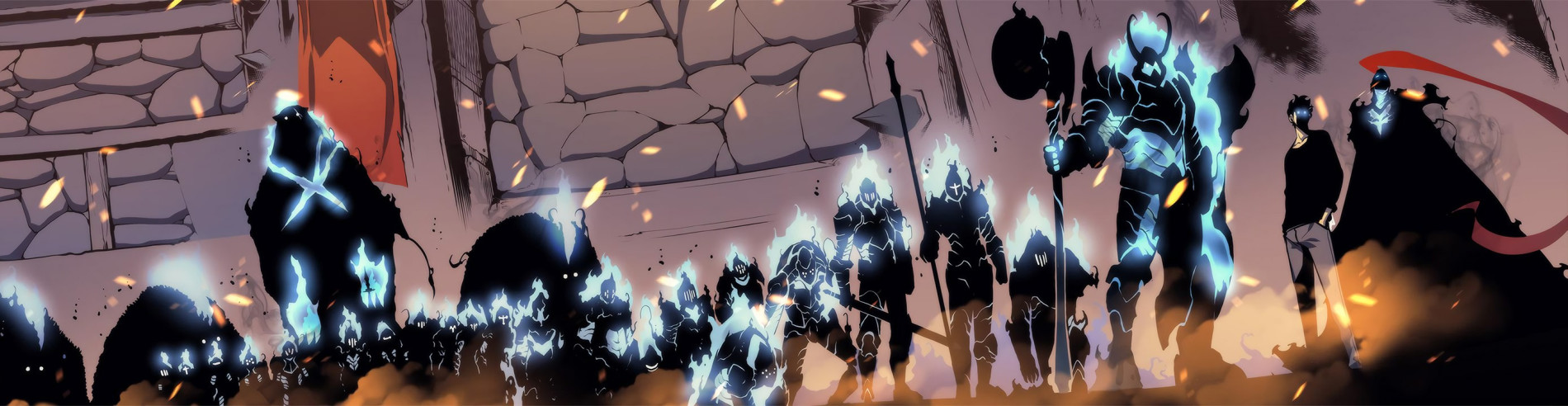
The visual design of the Shadow Monarch's powers deserves equal praise. The signature dark-purple and ethereal blue aura surrounding Jinwoo’s summoned soldiers seamlessly blends traditional 2D hand-drawn character designs with complex visual effects rendering, avoiding the rigid visual disconnect that often plagues digital magic in modern anime.
Soundtrack & Voice Acting
Composer Hiroyuki Sawano (renowned for his work on Attack on Titan and Kill la Kill) delivers a thunderous score alongside TOM-H@CK. The soundtrack masterfully blends aggressive electronic synths, heavy metal guitar riffs, and sweeping orchestral choruses. Tracks like the iconic Shadow Extraction motif elevate mundane moments into epic spectacles.
The voice cast performs at the top of their industry. Aleks Le (English Dub) and Taito Ban (Japanese Original) both convey Jinwoo’s transformation from a breathless, stuttering boy into an imposing, bass-heavy stoic. Furthermore, the sound design team excels in audio crunch: swords biting through armor, shadows slithering out of corpses, and monster roars carry a spatial depth that rewards headphone listeners.
Pros & Cons Breakdown
Strengths:- Unmatched Action Choreography: Fluid, weight-heavy combat sequences that set a high bar for modern urban fantasy anime.
- Exceptional Sound Design & Score: Hiroyuki Sawano's soundtrack elevates every encounter to legendary status.
- Pacing and Spectacle: Fast-paced narrative progression that rarely bogs down in unnecessary exposition.
- Visual Overhaul: Dramatic upgrades in lighting, particle effects, and environmental destruction compared to Season 1.
- Shallow Supporting Character Arcs: Side characters still primarily exist to react to Jinwoo's overwhelming power rather than driving their own independent storylines.
- Reduced Narrative Stakes: Once Jinwoo's abilities reach god-like levels, personal tension during minor battles evaporates.
- Frequent Cliffhangers: Episodes often cut off mid-battle, causing structural pacing frustration when viewed weekly.
Final Conclusion & Overall Rating
Solo Leveling: Arise from the Shadow solidifies its standing as the undisputed king of modern power-fantasy action anime. While purists seeking deep philosophical character studies or complex ensemble dramas might find its single-minded focus on Sung Jinwoo limiting, the series delivers its core premise with absolute perfection. It is a thrilling, visually gorgeous, and audio-visually relentless experience that understands precisely what its audience craves.
Final Rating: 8.8 / 10
Recommended For: Fans of battle shonen, video game RPG mechanics, dark fantasy, and high-budget action animation like Jujutsu Kaisen or Demon Slayer.